Updated August 15th, 2026

STEM toys cover a lot of ground, from quick logic puzzles that fit in a backpack to full electronics kits and telescopes that turn into years-long hobbies. The right pick really depends on what kind of learning your kid gravitates toward: hands-on puzzle solving, real circuits and wiring, coding and robotics, or hands-on science like astronomy.
We compared four STEM toys that each hit a different one of those angles: the ThinkFun Gravity Maze as the Best Value pick for logic and spatial reasoning, the Snap Circuits Classic SC-300 as the Best Overall pick for hands-on electronics, the ELEGOO UNO R3 Smart Robot Car Kit as the pick for coding and robotics-minded kids, and the Celestron StarSense Explorer DX 130AZ telescope as the Premium Pick for backyard astronomy.
As an Amazon Associate I earn from qualifying purchases. Links on this page are affiliate links.
We compared these STEM toys on price, age range, what kind of concepts each one actually teaches, and how each one holds up under real reviews, since "best STEM toy" depends heavily on which type of science or engineering a kid is drawn to. The ThinkFun Gravity Maze leads on value at $22.79 with a 4.6-star rating across 37,799 reviews. Snap Circuits Classic SC-300 is the most trusted electronics kit here, rated 4.8 stars across 29,245 reviews at $53.59. The ELEGOO UNO R3 Smart Robot Car Kit stands apart with real coding and robotics content for $79.99, backed by 4,464 reviews at 4.5 stars. And the Celestron StarSense Explorer DX 130AZ sits at the top of the lineup as a $449.99 telescope backed by a 4.1-star rating across 1,016 reviews.
Quick Notes
The ThinkFun Gravity Maze is our Best Value pick because it delivers a 4.6-star rating across 37,799 reviews for under $23, making it the most affordable way to build real logic and spatial reasoning skills. It's aimed at kids who enjoy hands-on puzzle solving more than screens or long instruction manuals. One concrete detail that matters is the set of 60 challenge cards ranging from beginner to expert, which means the puzzle keeps pace with a kid's skill instead of getting solved once and set aside. That range is what keeps it in rotation for years instead of weeks. A second detail is the instant, satisfying feedback loop: kids build a 3D tower layout, then drop the marble to see immediately whether their design worked. That immediate test-and-adjust cycle is what makes engineering-style thinking feel like play instead of school work. The tradeoff is depth — several reviewers noted the puzzles can feel too easy for older or more advanced kids once they've learned the underlying patterns, so it works best as an entry point rather than a long-term challenge for a dedicated puzzle solver. Skip this one if you want a kid to build real electronics or code. Buy it if you want the cheapest, most screen-free way to build logic and spatial reasoning skills.
Prices and availability were recorded when this article was written and are subject to change. The price and availability shown on Amazon at the time of purchase apply.
Quick Notes

The Snap Circuits Classic SC-300 is our Best Overall pick because it combines a 4.8-star rating across 29,245 reviews with a genuinely deep library of over 300 projects, making it the most trusted hands-on electronics kit for kids 8 and up. It's built for kids who want to actually build working circuits, not just watch a video about them. One concrete detail that matters is the snap-together design, which requires no soldering or tools of any kind. Numbered, color-coded pieces snap directly onto a plastic grid, which means a kid can go from opening the box to completing a working circuit in minutes rather than needing an adult to handle any wiring. A second detail is the sheer range of the 300-plus included projects, covering things like AM radios, burglar alarms, and doorbells. That range is what keeps kids coming back to the same kit for months, since there's always another project to try. The tradeoff is durability — several reviewers noted that individual circuit pieces can feel fragile with heavy repeated use, and the company does sell (and readily provides) replacement parts for exactly that reason. Skip this one if you want a kid to also learn to code. Buy it if you want the single most trusted, most rewarding hands-on electronics kit available.
Quick Notes
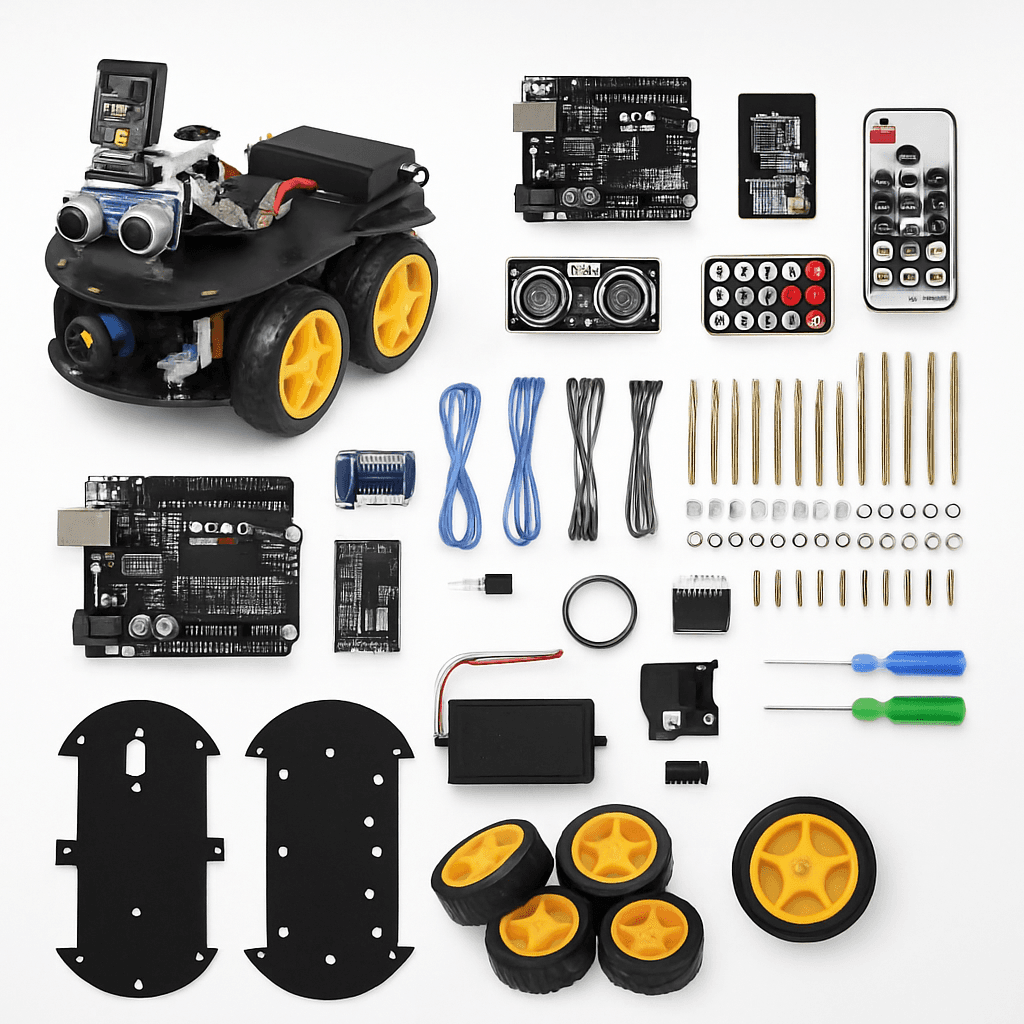
The ELEGOO UNO R3 Smart Robot Car Kit is our pick for coding and robotics because it gives kids hands-on experience with an actual Arduino-compatible board, something the other picks in this lineup don't offer. It's built for kids 8 to 16 who are ready to move past pre-built circuits into real programmable robotics. One concrete detail that matters is the multiple operating modes built into the kit: FPV camera control, line tracking, ultrasonic obstacle avoidance, and app or IR remote control. That range means kids aren't just building one static thing — they're exploring several different robotics concepts with the same physical car. A second detail is that the underlying code is open for editing through the Arduino IDE, so a more advanced kid or a parent working alongside them can go beyond the pre-loaded programs and start writing custom behavior. Several reviewers specifically called out this deeper coding path as the reason they chose it over a simpler pre-programmed toy. The tradeoff is assembly complexity: it involves quite a few small screws and wiring connections, and several reviewers noted it benefits from adult guidance, especially for kids on the younger end of the age range. Skip this one if you want an out-of-the-box toy with no assembly required. Buy it if you want a kid to get real, hands-on exposure to coding and robotics concepts.
Quick Notes

The Celestron StarSense Explorer DX 130AZ is our Premium Pick because it opens up an entirely different kind of STEM experience — real backyard astronomy — backed by a reputable telescope brand and a smartphone app that makes finding celestial objects approachable for a total beginner. It's built for families ready to invest in a hobby that can last for years. One concrete detail that matters is the patented StarSense sky-recognition technology, which uses your phone's camera to analyze star patterns overhead and pinpoint the telescope's exact position. That's what lets a first-time user find specific galaxies, nebulae, and planets on their very first night out, something that would otherwise take real practice with a traditional telescope. A second detail is the 130mm Newtonian reflector with high-reflectivity coatings, which gathers enough light to show genuinely detailed views of the Moon, Jupiter, Saturn, and deep-sky objects like the Orion Nebula. Reviewers with decades of amateur astronomy experience specifically praised the optical quality for a telescope in this price range. The tradeoff is the price and the mixed build-quality reports — some reviewers described a flimsy tripod or shaky image in windy conditions, and a couple reported shipping damage to the mirror. Careful assembly and gentle handling go a long way here. Skip this one if you want something budget-friendly or low-maintenance. Buy it if you want to give a kid a genuine, guided introduction to backyard astronomy and are ready for the investment.
Prices and availability were recorded when this article was written and are subject to change. The price and availability shown on Amazon at the time of purchase apply.
ThinkFun Gravity Maze
Snap Circuits Classic SC-300
ELEGOO UNO R3 Smart Robot Car Kit V4
Celestron StarSense Explorer DX 130AZ
Best Use
Logic and spatial reasoning
Hands-on electronics
Coding and robotics
Backyard astronomy
Recommended Age
Ages 8-12
Ages 8+
Ages 8-16
Ages 8+ (with adult help)
Price (when written)
$22.79
$53.59
$79.99
$449.99
Standout Feature
60 challenge cards from beginner to expert
300+ snap-together projects, no tools required
App, IR remote, and autonomous sensor-driven modes
Smartphone-guided sky navigation via the StarSense app
Why We'd Buy It
Cheapest way to build real problem-solving skills
Most trusted, most proven hands-on electronics kit
Only pick that teaches real coding and robotics
The most immersive, real-science STEM experience
If you want an affordable, screen-free way to build logic and spatial reasoning skills, the ThinkFun Gravity Maze covers that. Kids build a 3D marble run to solve puzzle cards ranging from beginner to expert, which keeps it challenging as they improve rather than becoming boring after a few tries.
If you want the single most trusted, most hands-on way to teach real electronics, the Snap Circuits Classic SC-300 is built for that. Its 300-plus snap-together projects require no soldering or tools, and its 4.8-star rating across nearly 30,000 reviews reflects just how consistently it delivers on that promise.
If you want a kid to get real exposure to coding and robotics instead of just circuits, the ELEGOO UNO R3 Smart Robot Car Kit is built for that. It’s based on an Arduino-compatible board, and once assembled it can be controlled by app, IR remote, or its own onboard sensors for obstacle avoidance and line tracking.
If you want to introduce a kid to hands-on astronomy and don’t mind the investment, the Celestron StarSense Explorer DX 130AZ is built for that. Its StarSense smartphone app uses sky-recognition technology to guide the telescope to specific objects, making real backyard astronomy approachable for a first-time user.
LEGO sets are another strong option for developing spatial reasoning and open-ended problem-solving; compare our LEGO recommendations for builders across different ages and skill levels.
Buy the ThinkFun Gravity Maze if you want an affordable, screen-free way to build a kid's logic and spatial reasoning skills.
Buy the Snap Circuits Classic SC-300 if you want the single most trusted hands-on electronics kit for a curious kid.
Buy the ELEGOO Smart Robot Car Kit if you want a kid to get real, hands-on exposure to coding and robotics.
Buy the Celestron StarSense Explorer DX 130AZ if you want to give a kid a real, guided introduction to backyard astronomy.
Choose the ThinkFun Gravity Maze if you want the most affordable way to build logic and problem-solving skills. Choose the Snap Circuits Classic SC-300 if you want the single most trusted hands-on electronics kit. Choose the ELEGOO UNO R3 Smart Robot Car Kit if you want real coding and robotics exposure. Choose the Celestron StarSense Explorer DX 130AZ if you want to introduce a kid to real backyard astronomy and are ready for the price tag.
If you're still not sure, Snap Circuits Classic SC-300 is the safest default: it's approachable for a first-timer, deep enough to hold a curious kid's attention for months, and its nearly 30,000 reviews make it the most proven pick in this lineup.
Related articles
Explore more expert comparisons and buying guides to help you find the perfect product.


As an Amazon Associate I earn from qualifying purchases.